Data and Methods for Identifying Artificial Intelligence-Related Patents
A PU learning-based label refinement framework for AI patent identification, demonstrating an F1 score improvement of up to 21% through data quality enhancement.

This research analyzes precision limitations in existing AI patent identification and improves performance via a PU learning-based label refinement framework. The proposed method increases F1 scores by 18-21% over AIPD, proving data quality is key to classification performance.
Introduction
In an enterprise environment, patent analysis of AI technology serves as a core metric for identifying competitor strategies and establishing R&D directions. However, because the definition of AI technology is broad and terminology is highly ambiguous, identification methods relying solely on keywords or existing classification systems carry the risk of generating numerous false positives.
Even for models trained on large-scale datasets, a gap emerges between benchmark figures and actual application results if the training data contains noise or fails to sufficiently reflect the domain context. This can lead to erroneous technical analysis, causing serious failures in a company’s strategic judgment.
This analysis examines why the design of a ‘data refinement pipeline’ is more decisive than the mere introduction of deep learning models, and how a domain-specific label refinement framework drives practical improvements in classification performance.
Key Findings of the Original Paper
This paper evaluates the performance limitations of existing methodologies for identifying AI-related patents, specifically the Artificial Intelligence Patent Dataset (AIPD) from the USPTO, and proposes a new framework for improvement. Using an independent ground-truth dataset of 4,000 expert-annotated cases, the researchers confirmed that existing methodologies lack precision and generalizability.
To address this, they developed an iterative label refinement framework inspired by the Cooperative Patent Classification (CPC) system and Positive-Unlabeled (PU) learning. The researchers constructed training data using USPTO and EPO patent abstracts from PATSTAT and employed a ‘spy’ technique to remove label noise and build a high-quality training set. Subsequently, they trained various deep learning and Transformer-based models, including CNN Text CA, Multi Self Attention, and SciBERT.
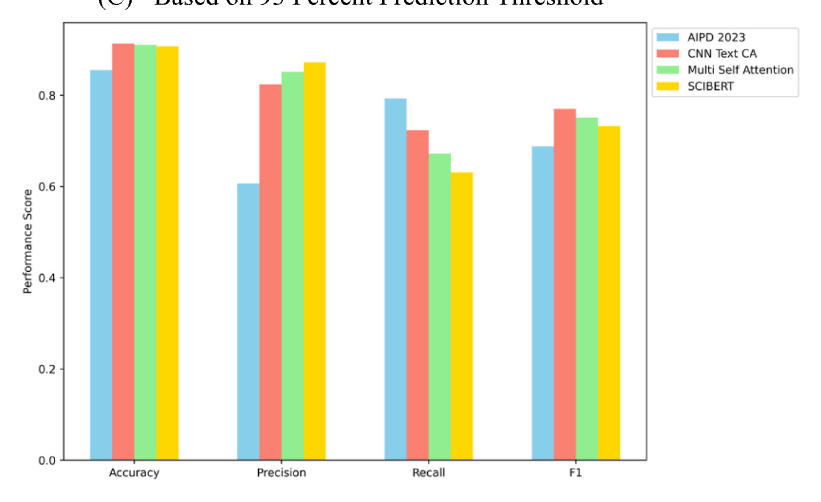
Experimental results showed that models trained with the proposed framework outperformed AIPD (2023); specifically, the CNN Text CA model improved the F1 score by 18-21% compared to AIPD. Furthermore, the researchers empirically validated the effectiveness of the proposed dataset by analyzing how the market value of AI patents rose and corporate innovation efforts were redistributed toward AI technologies following the release of ChatGPT.
Executive Key Takeaways
- 1 1. [Key Finding] Existing AI patent identification systems tend to have low precision and suffer from over-identification due to a lack of training data representativeness and lexical ambiguity.
- 2 2. [Practical Implication] To improve the classification performance of AI models, precise label refinement processes based on domain knowledge (e.g., CPC) and a data-centric approach must take precedence over simple changes to model architecture.
- 3 3. [Remaining Task] When the patent classification system itself fails to keep pace with the rapid evolution of AI technology, how should the CPC-based initial sampling strategy be dynamically updated?
What Are the Key Factors Determining the Precision of AI Patent Identification Models?
First, AIPD (2023), a representative existing dataset, exhibits serious flaws in precision. According to the original researchers’ evaluation using an independent ground-truth dataset, while AIPD reported high performance on its own test set, its F1 score dropped sharply on external datasets. This is a typical case of generalization failure occurring because the training data does not sufficiently represent the broad context of the AI domain, resulting in an over-identification problem where far more patents are misjudged as AI-related than actually are.
Second, lexical ambiguity acts as critical noise for classification models. According to the analysis in the source paper (Table 4 and Table 5 of the source paper), terms such as ‘Transformer’ or ‘Encoder’ are core AI technologies in the NLP field, but refer to general hardware components in electrical engineering or electronic circuitry. Existing models like AIPD fail to distinguish this domain context and make judgments close to simple keyword matching, resulting in high false positive rates in chemical synthesis or electronic component fields.
Third, the quality of training data, rather than the model architecture, determines the performance ceiling. Ablation tests conducted by the researchers showed that even when using the same LSTM-based structure, performance improved dramatically when trained on data that underwent CPC-based sampling and PU learning-based label refinement. This suggests that a ‘Data-centric AI’ approach—removing noise from training data by combining domain knowledge—is the key to practical performance improvement, rather than merely adopting the latest Transformer models or LLMs.
Many AI projects decide on production deployment based on high accuracy achieved in internal test sets, but as seen in the AIPD case, performance often collapses on external (out-of-sample) datasets. Especially in fields with strong term ambiguity across domains, such as AI patents, the trade-off between precision and recall must be analyzed more closely than simple performance metrics.
The ‘drop in precision’ that appears when training data is overfitted to specific patterns generates numerous false alarms in practice, becoming technical debt that completely destroys the credibility of the analysis results.
Operating Mechanism of the CPC-informed PU-inspired Label Refinement Framework
The framework proposed by the researchers maximizes the purity of training data through a three-stage workflow: data construction, label refinement, and model training (Figure 1 of the source paper). In the first stage, initial data construction, the hierarchical structure of the Cooperative Patent Classification (CPC) is precisely utilized. Based on WIPO’s AI technology classification system, 129 CPC codes were identified and expanded to their subclasses, deriving a total of 695 codes to build the positive samples pool. For negative sample construction, the researchers sampled both ‘hard negatives’ (technically adjacent to AI but not AI) and ‘easy negatives’ (completely unrelated) to ensure the model learns subtle semantic differences.
The second stage is the iterative label refinement process based on Positive-Unlabeled (PU) learning, the core of this framework. To remove label noise, the researchers introduced the ‘spy’ technique. This method involves intentionally inserting some samples of a specific class into the opposite class and setting a threshold based on how accurately the classifier identifies them. First, 100,000 negative samples were inserted as spies into the positive sample pool, and the point where 85% were reclassified as negative was set as the threshold to remove substandard samples. Subsequently, 50,000 positive samples were inserted into the negative sample pool, and a symmetric refinement process was performed to remove noise within negative samples based on the point where 99% were re-identified as positive.
In the third stage, various benchmark models are trained using the refined high-quality dataset. For text representation, the Bag of Words (BoW) method was applied to traditional machine learning models, and word embedding was applied to deep learning and Transformer-based models. Specifically, various neural network structures such as CNN Text CA, Multi Self Attention, and SciBERT were tested to select the optimal performing model. This process proved that data quality improvement via the refinement pipeline, rather than simple model performance gains, was the decisive factor in increasing the F1 score.
This refinement process includes a manual verification stage combining domain knowledge in addition to automated PU learning. The researchers randomly extracted samples by CPC class and subclass to manually review abstracts, identifying and removing 575 CPC classes with high false positive rates. Additionally, a final filtering step was applied to exclude patents from the positive set that had no AI-related lexical indicators, utilizing keyword lists from WIPO and previous research. This demonstrates that from a Data-centric AI perspective, removing noise from source data is the core mechanism determining the generalization performance of the model, more so than simple algorithmic sophistication.
Analysis of Over-identification Causes and Structural Precision Defects in AIPD
The most fatal defect exposed by the AIPD (2023) dataset is the over-identification problem, where far more patents are classified as AI-related than actually are. Analysis by the original researchers showed that based on a 50% prediction threshold, AIPD judged approximately 18.9% (2.92 million) of USPTO patents and published patents (PGPubs) between 1976 and 2023 as AI-related. This figure is 3 to 4 times higher than estimates from research institutions such as WIPO or CSET, suggesting that a serious degradation of precision is structurally inherent throughout the system.
The root cause of this precision defect is the mass occurrence of false positives based on lexical ambiguity. According to the source paper’s Table 4 and Table 5 of the source paper, which compare the prediction results of the CNN Text CA model and AIPD, AIPD showed high AI patent determination rates even in non-AI domains such as chemical synthesis (C12P, C08G) or electronic components (H01G). This occurred because the model relied only on the surface meaning of words and failed to distinguish contexts that vary by domain.
Examining specific misclassification cases, typical examples include ‘Transformer’ (a core technology in NLP) being mistaken for a ‘transformer coil’ in electrical engineering, and ‘Encoder’ (a component of GANs) being mistaken for a ‘digital signal encoder’ in electronic circuitry. This reveals the limitation where deep learning models recognize certain keywords as strong AI signals but fail to perceive that the technical context in which the term is used concerns hardware components unrelated to AI.
Consequently, the failure of AIPD stems from defects in training data composition rather than model architecture. Through ablation tests, the original researchers proved that performance diverged sharply depending on the level of training data refinement, even when using the same LSTM-based structure. In particular, the small-scale manual labeling method used by AIPD failed to sufficiently reflect the contextual diversity of the vast and heterogeneous AI domain, leading to overfitting on specific lexical patterns and the subsequent collapse of precision.
This over-identification is more than a numerical error; it becomes a dangerous metric that distorts the measurement of AI technology’s diffusion path and innovation speed. A model that makes keyword-centric judgments while excluding domain context generates numerous false alarms in practice, ultimately acting as decisive technical debt that destroys the reliability of AI technology analysis.
Empirical Application of AI Patent Identification Results: The ChatGPT Shock and Market Value
Precisely identified AI patent data serves as a powerful tool for analyzing the impact of massive technological shocks on corporate value and strategic resource allocation, beyond simple technical statistics. To validate the effectiveness of the dataset constructed with the proposed framework, the researchers analyzed the impact of the technological shock of the ChatGPT release in November 2022 on the market and corporate behavior through two empirical cases.
The first analysis measures changes in the economic value of AI patents. The researchers performed regression analysis using the Kogan Patent Stock Score (KPSS), which calculates patent value through abnormal stock returns around the time of patent grant for listed companies. According to Table 7 of the source paper, prior to the release of ChatGPT, AI-related patents showed no significant difference in market value compared to non-AI patents or even tended to be slightly lower. However, after the release, the value of AI patents rose significantly by approximately 1% to 8% compared to non-AI patents. This suggests that the emergence of disruptive innovation technology caused a rapid re-evaluation of the market value of previously undervalued AI-related intellectual property.
The second analysis examines how corporate innovative effort was redistributed. A Poisson Regression model was applied to analyze changes in the number of AI patent filings versus non-AI patent filings for high-tech companies. Analysis of Table 8 of the source paper showed that after the release of ChatGPT, both the number of AI patent filings by high-tech companies and the proportion of AI patents among total filings increased statistically significantly. In contrast, non-AI patent filings did not show such a distinct upward trend. This proves that companies did not simply expand their overall R&D scale but shifted their strategic priorities toward AI technology and redistributed resources accordingly.
These empirical results show that securing precise identification data is a prerequisite for deriving business insights. If a dataset with many false positives like AIPD had been used, patents unrelated to actual AI technology would have been included in the analysis, likely diluting the pure value increase and strategic transition effects following the technological shock. Ultimately, high precision secured during the data refinement stage is the decisive factor that clearly visualizes the actual correlation between technological inflection points and corporate financial value and R&D strategy by removing noise from the analysis results.
Data Refinement Checklist for Building Domain-Specific Classification Models
- Domain-Based Initial Sampling: Was the initial pool of positive/negative samples constructed using a hierarchical classification system like CPC rather than simple keywords?
- Securing Hard Negatives: Were cases that are technically adjacent to AI but not AI (e.g., general data processing) intentionally included to increase the model’s discriminative power?
- Iterative Label Refinement Pipeline: Is there an automated refinement process to statistically identify and remove noise within the data, such as PU learning or the spy technique?
- Lexical Ambiguity Review: Have cases where the same term is used differently across domains been fully surveyed, and has the model been trained with sufficient contrast samples to distinguish them?
Implications from the Perspective of Enterprise AI Classification System Design
This research clearly demonstrates that the latest LLM (GPT-4o) has lower classification performance than a sophisticatedly designed supervised learning model without domain-specific fine-tuning. This suggests that the tendency of many companies to build classification systems relying on the zero-shot capabilities of general-purpose LLMs can be risky. Ultimately, for precise classification in a specific domain, the ability to build a ‘reliable small dataset’ is more important than model selection.
The label refinement method applying PU learning is a very practical approach in enterprise environments where ground-truth labels are difficult to obtain. In situations where full manual inspection by experts is impossible, building a pipeline that removes noise through statistical techniques can be an efficient strategy to secure model reliability while lowering data acquisition costs.
Three Principles for Building High-Precision Domain Classification Models
In classification projects where data noise becomes the performance bottleneck, the following core principles should be observed:
- Data-Centric Performance Optimization: Allocate more resources to the refinement process that increases the label purity of training data than to tuning model architecture.
- Integration of Hierarchical Domain Knowledge: Do not rely solely on the statistical learning of machine learning; utilize standard classification systems like CPC as constraints for initial sampling and filtering.
- Generalization Evaluation Based on External Validation Sets: Do not overtrust the performance of internal test sets; rigorously verify generalization performance through independent expert-annotated data or external benchmarks.
Further reading
- End-to-End Data Quality-Driven Framework for Machine Learning in Production Environments
- Cheating Behavior in Frontier Model Evaluations
- Evaluation Blindness: How Silent Measurement Failures Corrupt AI Systems from Training to Deployment
References and Original Analysis Materials
Data and methods for identifying artificial intelligence-related patents
Authors: Tianjun Wu, Chao Min, Waverly W. Ding, Guolong Wang, Kunpeng Zhang
This research briefing was written from the source paper with the help of AI tools (AI Research Agent · MLOps, AI Research Agent · Strategy). Reviewed by Jay PARK, who is responsible for it.
Read more

Papers & Reports ·
Working with AI: AI Adoption Strategies and Organizational Restructuring Based on Anthropic Enterprise Customer Interviews

Papers & Reports ·
How to Outcompete Your Client's AI

Papers & Reports ·
Risks of Governance Absence: Lessons from AI Adoption at the U.S. Small Business Administration (SBA)

Papers & Reports ·
Cheating Behavior in Frontier Model Evaluations